
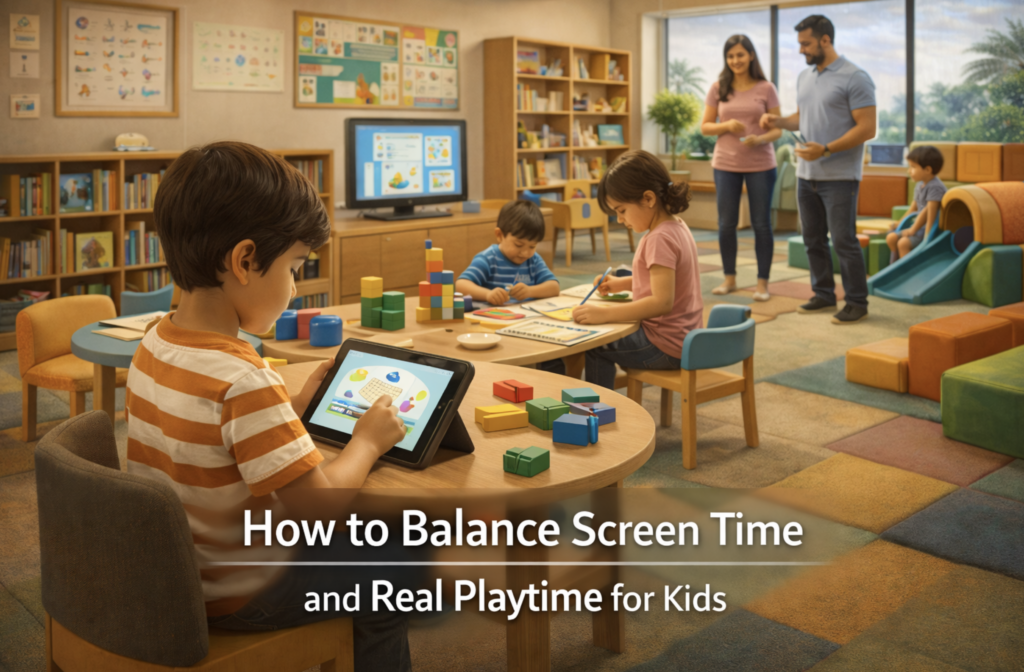
Screens are part of everyday life. From cartoons and learning apps to video calls with family and school-related activities, children are surrounded by screens more than ever before. For parents, this often leads to an ongoing question, how much screen time is okay, and how do we make sure kids still get enough real playtime?
The goal isn’t to eliminate screens completely. It’s to create a healthy balance where screens support learning and connection, while real play supports physical, emotional, and social development. Finding that balance looks different for every family, and that’s completely okay.
Why Both Screen Time and Playtime Matter
Screens and play serve different purposes in a child’s life.
Screen time can offer:
- Educational content
- Entertainment and relaxation
- Exposure to language and ideas
- Connection with family or classmates
Real playtime supports:
- Physical development and coordination
- Creativity and imagination
- Social skills
- Emotional regulation
- Confidence and independence
Children need both. Problems usually arise not because screens exist, but when they replace movement, exploration, and interaction for long periods.
Understanding Screen Time by Age
Not all screen time affects children the same way. Age plays a big role.
Toddlers (1–3 years)
At this age, children learn best through movement, touch, and interaction. Short, supervised screen time can be fine, especially educational content, but it shouldn’t replace physical play.
Preschoolers (4–5 years)
Preschoolers can benefit from interactive and educational programs, but they still need plenty of real-world play to develop motor skills and social confidence.
School-Age Kids
Older children may use screens for learning, homework, and social interaction. Balance becomes more about boundaries and variety rather than strict limits.
Why Real Playtime Is Essential
Real play allows children to use their bodies and minds together. When kids climb, build, pretend, or run, they’re learning how the world works through experience.
Playtime helps children:
- Burn energy in healthy ways
- Improve balance and coordination
- Practice communication and cooperation
- Develop problem-solving skills
- Manage emotions naturally
Without enough play, children may become restless, irritable, or overly dependent on screens for stimulation.
Signs Screen Time Is Taking Over
Every child is different, but some common signs that screens may be dominating include:
- Resistance when asked to turn screens off
- Loss of interest in toys or outdoor play
- Difficulty focusing during non-screen activities
- Increased irritability or meltdowns
- Reduced physical activity
These signs don’t mean screens are “bad,” they simply signal that it may be time to rebalance.
Simple Ways to Encourage More Real Play
Balancing screen time doesn’t require strict rules or constant battles. Small, consistent habits often work better.
Create Screen-Free Zones or Times
Mealtimes, bedrooms, and the first hour after school can be screen-free to encourage conversation and movement.
Offer Play Before Screens
Encourage children to play first, then enjoy screen time later. This helps them release energy and focus better.
Keep Toys Visible and Accessible
Children are more likely to play when toys, books, and art supplies are easy to reach.
Join In When Possible
Even short moments of shared play make a big difference. Children often stay engaged longer when parents show interest.
Use Screens Intentionally, Not Automatically
Instead of turning on a screen out of habit, ask:
- Is my child tired or bored?
- Do they need movement or rest?
- Would another activity work better right now?
When screens are used intentionally, they become a tool rather than a default.
Balancing Screen Time in a Busy Schedule
Many parents feel guilty about screen time because life is busy. Work, household responsibilities, and school schedules make screens convenient.
Balance doesn’t mean perfection. It means awareness.
Some realistic strategies include:
- Choosing quality content over quantity
- Setting clear start and end times
- Encouraging play immediately after screen use
- Planning at least one active activity daily
Even small changes make a difference.
Why Indoor Play Spaces Help with Balance
In places where outdoor play isn’t always practical, especially during hot or dusty days, indoor play spaces help children stay active.
Soft play environments, family cafés, and indoor activity centers provide opportunities for real play without weather concerns. For families in Dhahran, places like Twinkle Fun & Yum offer a balance by giving children space to move and explore while parents relax nearby, making it easier to reduce reliance on screens.
Teaching Kids to Self-Regulate Screen Use
As children grow, the goal is to help them understand balance themselves.
You can encourage this by:
- Talking openly about screen limits
- Explaining why playtime matters
- Modeling balanced behavior
- Allowing children to make choices within boundaries
Children who understand why limits exist are more likely to respect them.
What a Balanced Day Might Look Like
A balanced day doesn’t need to be rigid. For example:
- Morning: active play or outdoor time
- Midday: quiet activity or reading
- Afternoon: creative play or indoor activity
- Evening: limited screen time and family interaction
Flexibility is key. Some days will lean more toward screens, others toward play, and that’s normal.
Final Thoughts
Balancing screen time and real playtime isn’t about strict rules or guilt. It’s about creating space for movement, creativity, and connection alongside technology.
When children have opportunities to play freely, explore safely, and rest when needed, screens naturally take their place as one part of a healthy routine, not the center of it.
With awareness, flexibility, and small daily choices, families can find a balance that works for everyone.